


Feeling Lost in Retirement: The Part Nobody Warns You About


Eight months into retirement, I was busy every day and still couldn't tell my husband what I'd actually done with the time.
Ed would ask at dinner. Not in a pointed way, just making conversation. And I'd come up empty. I'd been moving since 7:30 that morning. Errands, a load of laundry, a few emails, a walk. The day was full. It just wasn't adding up to anything I could name.
That's the part nobody warns you about. The money panic is over. You got through the first few months. And then you land in a stretch that feels flat, and you start to wonder, quietly, whether this is all there is.
The first crisis ends. The harder question shows up later.
Most retirement advice stops at the finish line. Save enough, then relax, as if the hard part were the math.
The first 90 days are their own kind of hard. That disorientation right after you leave, when the routine that held your whole week goes away. I wrote a whole book about those first 90 days. But getting through them isn't the same as arriving.
Somewhere around month 6 or 8, the relief of not working wears off. The calendar fills back up. And something is still missing, even though nothing is wrong. Researchers have described this let-down stage for a long time. The sociologist Robert Atchley named it the disenchantment phase back in 1976, the flat patch that tends to follow the early honeymoon of retirement. Naming it helped me. It meant I wasn't broken. I was on schedule.
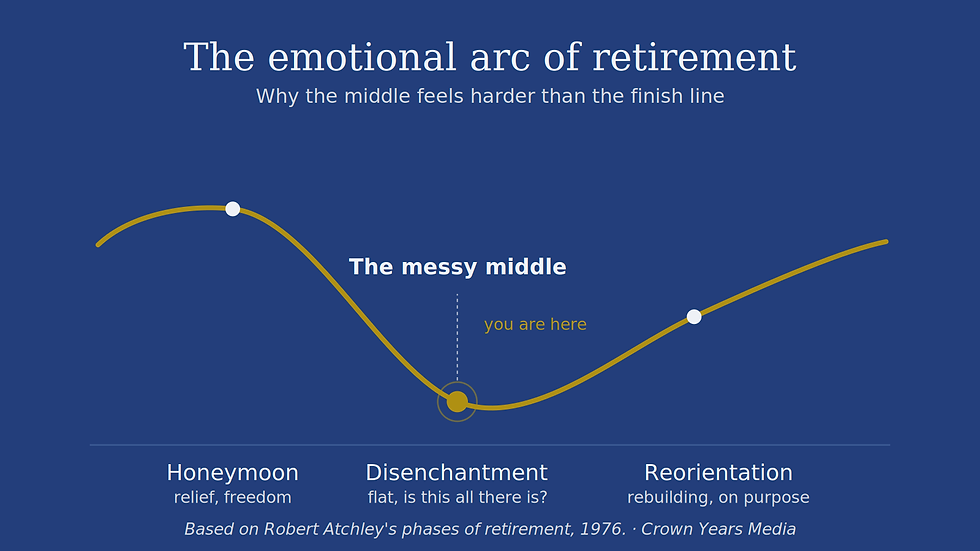
Busy is not the same as thriving
I did what everyone says to do. I filled the days. I organized my yarn by color and weight. I took the walks. I said yes to things.
And I still felt flat.
Here's what took me a while to see. Filling time and spending it well are two different skills, and nobody teaches you the second one because you never needed it before. Work spent your time for you. It told you where to be and what mattered by Friday. Take that away and a full day can still feel like nothing, because full was never the point. Meaning was.
I remember finishing a knitting project I'd pushed through in a couple of days and feeling almost guilty about it, like I'd only earned the rest if I had something to show. That guilt is worth paying attention to. It's a clue about what you think you're allowed to feel.
"Is this all there is?" is a real question, not a red flag
The hardest part wasn't the flatness. It was the shame under it.
I have it good. I know I have it good. So who am I to feel let down? That's the loop most of us get stuck in, and it keeps us quiet. We downplay it. We say we really shouldn't complain. And then we carry it alone, which makes it heavier.
You're allowed to grieve the job even if you don't miss the work. You're allowed to feel unproductive without earning it first. A normal, rocky adjustment does not mean something is clinically wrong with you.
I do want to say one thing plainly, because it matters. There's a difference between the flat middle I'm describing and real depression. If the heaviness doesn't lift, if you've lost interest in the people and things you love, if getting through the day is a struggle, that's worth taking to a doctor or a therapist. This isn't that. If that's the case for you, please seek the appropriate support.
What the messy middle actually asks of you
The flat stretch isn't one problem with one fix. It's five parts of your life shifting at the same time, quietly, while you're not looking.
Your money, and whether you can permit yourself to spend what you spent decades saving. Your identity, once your title stops answering the question of who you are. Your friendships, which don't hold themselves together anymore now that work isn't doing it for you. Your sense of purpose, which changes on you. And your marriage, suddenly under the same roof all day with no shared schedule to lean on.
Those five run through everything in this stage. The new book walks through each one, and every chapter ends with a real tool, not just a nice thought. Insight plus something to actually do.
You don't have to white-knuckle it
I wrote this book from the middle of my own retirement, not the far side of it. I'm still building mine. Some weeks are good, and some are flat, and I've stopped treating the flat ones as proof that I got it wrong.
If you're in that stretch right now, functioning but not thriving, wondering if this is all there is, I wrote The Messy Middle of Retirement for you. It's the second book in The Retirement Journey Series, and it stands on its own. You don't need the first one to start here.
Get the book on Amazon: The Messy Middle of Retirement
And if you want the free Retirement Readiness Assessment, plus honest writing like this in your inbox, join the email list here. No pep talks. Just the truth about the middle, from someone still in it.



Comments